Showing posts with label Goizueta9. Show all posts

Monday, August 31, 2020

Goizueta Gardens: Entrance Gardens

With more than 5,000 flowering perennials and native grasses, visitors to the Atlanta History Center are in for a beautiful welcome exploring the new Entrance Gardens, one of the nine gardens within Goizueta Gardens here.

Atlanta History Center | Entrance Gardens | Photo: Travis Swann Taylor

Completed in 2020, this year, this new garden space is already a big hit, whether viewing on your way into the museum building, enjoying lunch outside of Souper Jenny, or relaxing at the new wood tree table

Atlanta History Center | Entrance Gardens | Photo: Travis Swann Taylor

It's planted in a naturalistic design, not over-designed and complicated, making it a more relaxing experience.

Atlanta History Center | Entrance Gardens | Photo: Travis Swann Taylor

A spectacular masterpiece of the new gardens is the “tree table,” a 60-foot-long work of art made from a declining oak that had graced the campus for 130-plus years. Now it will continue to host visitors in a different fashion. I'm so glad it's still here and did not go to the wood chipper! 

Atlanta History Center | Entrance Gardens | Photo: Travis Swann Taylor

The repurposed tree was sliced vertically and is now laid out in the tree's original silhouette ... it's brilliant! Can't you see yourself here enjoying lunch or an afternoon snack or reading a book from the gift shop?

Atlanta History Center | Entrance Gardens | Photo: Travis Swann Taylor

The flowers are beautiful, some of them familiar while others species might be a temporary mystery, but lovely all the same.

Atlanta History Center | Entrance Gardens | Photo: Travis Swann Taylor

It was obvious from the beginnings of this garden that it's planted with flowers that attract bees and butterflies. Keep your cameras at the ready!

Atlanta History Center | Entrance Gardens | Photo: Travis Swann Taylor

I don't know if this side area is considered part of the Entrance Gardens, but it's opposite the parking deck so I included it, because it's so beautiful. 

Enjoy your visit!

The Other Gardens: This is the ninth and final post in a series sharing the beauty of the nine gardens on the Atlanta History Center's 33-acre campus. You can find them all here.

Friday, August 21, 2020

Goizueta Gardens: Veterans Park

"Each packet of soil represents a place, a time and a mission where the sons and daughters of this great country showed their commitment to the values we treasure," said Richard A. Lester, retired Army lieutenant colonel and keynote speaker at the re-dedication ceremony of Veterans Park at the Atlanta History Center on Memorial Day in 2013.

Veterans Park | Atlanta History Center | Photo: Travis Swann Taylor

This magnificent three-quarter-acre park was placed precisely at the corner of West Paces Ferry Road NW and Slaton Drive NW, typically the first part of the Atlanta History Center's 33-acre complex that visitors glimpse. Mere steps from the main entrance, Veterans Park welcomes all to engage in personal reflection, and to "ignite profound connections with veterans and honor the lives of those who have made great sacrifices for our freedom.

This park is not only for those who made the greatest sacrifice, but for those protecting our freedoms today, right this very second, as well as for future generations.

The centerpiece of the park is an eight-foot diameter Seal of the United States carved from granite sourced from Elberton, Georgia, known as the "Granite Capital of the World!" Placed under this great Seal is a "Sacred Soil" collection, including soil from every major conflict where the United States has engaged, from the Revolutionary War to Afghanistan. 

Veterans Park | Atlanta History Center | Photo: Travis Swann Taylor

The park is flanked by two tranquil, cascading water features in short, brick wall basins with multiple vertical splashes.

The packets of soil that Lester was referring to were scattered at the base of flags, gallantly swaying over Veterans Park, during the 2013 re-dedication ceremony by veterans and Gold Star family members. 

Today's annual tradition at Veterans Park is a ceremonious gathering on Veterans Day of veterans and civilians with the program focusing on a different conflict or major military anniversary. The ceremony includes a color guard presentation, playing of our national anthem, sometimes bagpipes, and always a guest keynote speaker.

It's a beautiful yet somber event, but wonderful in that we get to meet veterans and thank them personally for their service.

Veterans Park | Atlanta History Center | Photo: Travis Swann Taylor

Slightly smaller than the centerpiece Seal at six-feet in diameter, but just as magnificent, are five additional Seals of each of the branches of the United States armed forces: United States Air Force, United States Army, United States Coast Guard, United States Marine Corps, and the United States Navy.

I was a Radioman in the U.S. Navy, so that's the seal that I gravitate to on each visit to Veterans Park. I admire how this particular park recognizes so many of our armed forces men and women. Other monuments and memorials are amazing, but this one looks back, is in the now, and has eyes forward in gratitude to the service men and women protecting our freedoms.

Veterans Park | Atlanta History Center | Photo: Travis Swann Taylor

There are panels, on brick pylons, throughout Veterans Park with quotes from interviews with veterans, part of the Atlanta History Center's Veterans History Project. An active program since 1999, it's "dedicated to collecting, preserving, and sharing veteran stories so that future generations can hear directly from those who served and better appreciate the realities of war and peacetime service."

Each panel has a QR Code, compatible with any smartphone, that links to videos in the Veterans History Project's collection of veterans sharing their stories.

Veterans Park | Atlanta History Center | Photo: Travis Swann Taylor


"For those who have fought for it, 
life has a flavor the protected shall never know."


Veterans Park | Atlanta History Center | Photo: Travis Swann Taylor

The cast eagle in the park is a gift from Lloyd and Mary Ann Whitaker, who were also instrumental in supporting the move of the Battle of Atlanta cyclorama painting from Grant Park to the Atlanta History Center. The stone base was quarried in Olympia, Greece, and was a gift from the Deppie and Lou Zakas family and the UPS Foundation

The original Veterans Park, opened in 2000, was situated around a single Vietnam War marker. After 9/11, the greenspace was a locale where Atlantans planted countless tiny American flags grieving those lost in the terrorist attack. 

It took a few more years, but today's Veterans Park, possible through a generous donation of $500,000 by The Home Depot Foundation, is one that Atlanta can be proud of, especially that it honors all who have donned a U.S. Armed Forces uniform, as well as all those who currently do and will.

Veterans Park | Atlanta History Center | Photo: Travis Swann Taylor

A plaque at the corner entrance to Veterans Park reads:

Veterans Park

Dedicated May 27, 2013, to honor all
those who have served and continue to
serve the United States of America.
protecting freedom around the world.

Let every nation know, whether it wishes us well
or ill, that we shall pay any price, bear any
burden, meet any hardship, support any friend,
oppose any foe to assure the survival and the
success of liberty.

President John F. Kennedy
January 20, 1961


Veterans Park | Atlanta History Center | Photo: Travis Swann Taylor

The fan-shaped park is a lovely greenspace with numerous benches where visitors can relax and reflect. The park is free and open to the public, too. 

If you want to visit the whole of the Atlanta History Center, just head to the main entrance beyond The Lloyd and Mary Ann Whitaker Cyclorama Building. If you're visiting at lunchtime, check out Souper Jenny, also at the front.

Veterans Park | Atlanta History Center | Photo: Travis Swann Taylor

For such a small footprint, this modest park has an immense mission, one that I believe it's dong well. This former sailor is incredibly grateful to the Atlanta History Center for their Veterans History Project and for their wonderfully honorable Veterans Park.

The Other Gardens: This is the eighth post in a series sharing the beauty of the nine gardens on the Atlanta History Center's 33-acre campus. You can find them all here.

Monday, August 3, 2020

Goizueta Gardens: Olguita's Garden

If you've lived in Atlanta for a month or a lifetime, or even if you've visited Atlanta for a long weekend, you've been touched by the work and the incredibly generous philanthropy of the Goizueta family.

Olguita Casteleiro de Goizueta held many leadership roles through volunteer work with the Atlanta History Center, the Latin American Association, the Atlanta Symphony Orchestra, the High Museum of Art, and many others. Her husband, Roberto C. Goizueta, is well-known as the former Chairman and CEO of The Coca-Cola Company who grew the company from $4.3 billion in 1981 to a high of $145 billion (some sources cite $180 billion) in 1997, the year of his death. That transformation of The Coca-Cola Company created a large number of millionaires in Metro Atlanta.

Olguita's Garden | Atlanta History Center | Photo: Travis Swann Taylor

The Goizueta Foundation was formed only a few short years before Roberto's death in 1997, aged 65. Shortly after his death, Olguita became trustee and chairman of the Foundation and ran it most of the years of the rest of her life. 

Since its founding in the early 1990s, the Goizueta Foundation has provided support for more than 297 organizations through 638 grants, totaling more than $601,000,000!

On the occasion of Olguita's 80th birthday, her children gifted her a life-size portrait of her and her husband, by Atlanta artist Ross Rossin, displayed at the offices of The Goizueta Foundation. Perhaps the only more famous image of the two is one of them when they were teenagers on a date, both holding bottles of Coca-Cola.
Olguita's Garden | Atlanta History Center | Photo: Travis Swann Taylor

Olguita, with her three children, stepped off a boat in Miami, having fled Fidel Casto-ruled Cuba. Roberto joined them soon after. They arrived in the U.S. with $40 and 100 shares in Coca-Cola stock (Roberto had worked for Coca-Cola when in Cuba).

Olguita's Garden | Atlanta History Center | Photo: Travis Swann Taylor

She was a former member of the Board of Trustees of Emory University, where the business school is named for her husband, Emory University's Goizueta Business School

Olguita Casteleiro de Goizueta passed on November 16, 2015, aged 81. Olbuita's life was celebrated in a special service at the Monastery of the Holy Ghost with family, Foundation staff, her caregivers, and closest friends. 

Following Olguita's passing, the Board of Directors of the Goizueta Foundation includes the Goizueta's three living children, Olga Goizueta Rawls (chair and CEO), Javier Goizueta, and Roberto Goizueta.

Olguita's Garden | Atlanta History Center | Photo: Travis Swann Taylor

The Goizueta Foundation has been generous to the Atlanta History Center since the early 1990s. Their initial grant to the Atlanta History Center was "to support educational programs" was for $75,000.

The Foundation's granting process focuses primarily on institutions of education and educational programs. They do not fund religious or political persons or entities. Their reach is a 10-county region in Metro Atlanta. 

Olguita's Garden | Atlanta History Center | Photo: Travis Swann Taylor

To help visitors understand why you see the name Goizueta around the 33-acre campus of the Atlanta History Center, here are some of the contributions made to the Center by the Goizueta Foundation over the years:

1993-1996 - $75,000 to support education programs. 

1998 - $100,000 to support the Folk Life Festival.

2001 - $358,750 to develop and support the Distance Learning program for three years, and to expand and support the Outreach Program for three years.

2010 - $829,750 to implement a new education initiative to modernize the current curriculum as well as execute a new marketing program.

2013 - $3,000,000 to support the 33-acre Historic Gardens and Trails to engage new audiences through expansive historic outdoor spaces. 

2016 - $4,500,000 to establish and endow the Olga C. de Goizueta Memorial Garden, and to establish The Goizueta Foundation Endowed Fund for the Olga C. de Goizueta Gardens.

2017 - $4,000,000 to support Goizueta Gardens’ Living Collections management; to support rebranding of Goizueta Gardens' signage and marketing efforts over four years; and to establish The Goizueta Foundation Endowed Fund for Goizueta Gardens.

I am one of millions of Atlantans who are grateful to the Goizueta family for their thoughtful generosity and to the Atlanta History Center for being such mindful stewards of those kind gifts.

Olguita's Garden | Atlanta History Center | Photo: Travis Swann Taylor

Planted along the outside wall of this garden, look for the special camellia—the "Olguita" camellia—introduced by the Atlanta History Center in 2018 in honor of Olguita C. de Goizueta.

Olguita's Garden | Atlanta History Center | Photo: Travis Swann Taylor

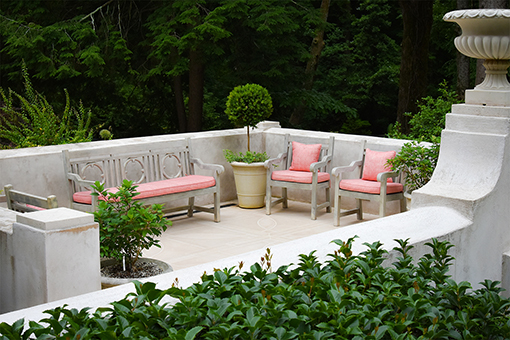
While "Goizueta Gardens" encompasses all of the gardens throughout the Atlanta History Center's 33 acres, "Olguita's Garden" is relatively new and it's absolutely stunning! Located just outside the back of the Museum Building, on the way to Swan House or Smith Family Farm, it's a beautifully landscaped ornamental garden with numerous flowers—particularly magnificent in the spring, but planted for year-round interest—espalier Keiffer pear trees, and comfortable antique French outdoor furniture for lounging. 

The focal point of the garden is a water feature surrounded by limestone columns designed by renowned Atlanta architect Neel Reid.

Olguita's Garden | Atlanta History Center | Photo: Travis Swann Taylor

This is the perfect spot for a small wedding or other social occasion! Ask any of the staff about hosting a special event here or visit the Private Events page on their website.

Olguita's Garden | Atlanta History Center | Photo: Travis Swann Taylor

Olguita and Roberto had a fourth child in 1966 after coming to the United States, a son named Carlos, but tragically he passed of leukemia at a very early age, in 1970.

Olguita was a faithful member of Holy Spirit Catholic Church in Atlanta and frequently visited the Monastery of the Holy Spirit in Conyers, Georgia, where a statue of the Virgin Mary and Baby Jesus are centered in the Memorial Plaza and Prayer Walk, gifted by Olguita Goizueta. There are plaques honoring the memory of her late son Carlos, as well as plaques for her and her late husband Roberto.

Olguita's Garden | Atlanta History Center | Photo: Travis Swann Taylor

When you next visit the Atlanta History Center's nine gardens, collectively named "Goizueta Gardens", be sure to stop by Olguita's Garden and explore and/or relax for a few minutes. Enjoy this lovely respite from busy city life. It's waiting just for you!

The Other Gardens: This is the seventh post in a series sharing the beauty of the nine gardens on the Atlanta History Center's 33-acre campus. You can find them all here.

Wednesday, July 22, 2020

Goizueta Gardens: Swan House Gardens

Ask almost any Atlantan and they can tell you at least a little about the Swan House and the Swan House Gardens. Ask a Swan House enthusiast and you'll need to pull up a chair. In the same vein, ask about architect Philip Trammell Shutze and you're likely first to hear about Swan House. Its design inspired by classical Italian and English styles, Shutze created what was then, and even today, one of the most celebrated private homes in Atlanta.

The home was acquired by the Atlanta History Center in the mid 1960s and opened to the public in 1967, a delight to locals and visitors from around the world since.

Swan House Gardens | Atlanta History Center | Photo: Travis Swann Taylor

While the Inman family lost much of its wealth during the US Civil War, Edward Hamilton Inman (1881-1931) inherited a large cotton brokerage fortune. His interests included real estate, transportation, banking, and politics. He served on the City Council and at one point ran for mayor. He married Emily Caroline McDougal (1881- 1965) whose interests included philanthropy, politics, and society. The effects of their philanthropy continues to abound in Atlanta.

The Inman's built Swan House, completed in 1928, for more than $100,000 at a time when the average cost of a new home was $2,000, so you can imagine its splendor, which includes its acres of magnificent gardens.

The cascading fountain at the front of the house was designed after a similar one at Villa Corsini in Italy. Atop the attic cornice are two allegorical statues of "Spring" and "Autumn", the seasons during which Swan House Gardens are most spectacular. Their epic "front yard" is comprised of multiple tiers of gorgeous green grass, retaining walls, and fountains. Swan House is one of the most photographed structures in Atlanta.

Swan House Gardens | Atlanta History Center | Photo: Travis Swann Taylor

The open arm stairway leading the the front door of Swan House is embellished with yellow Lady Banks Roses, a pop of complimentary color to the round-arched wall niches flanking the doorway, each inset with a shell motif and colored with sienna stucco. Lady Banks Roses are named for the wife of Sir Joseph Banks, renowned botanist and director of the Royal Botanic Gardens at Kew in southwest London along the River Thames.  

Swan House Gardens | Atlanta History Center | Photo: Travis Swann Taylor

Philip Trammell Shutze, still considered one of Atlanta's greatest architects, designed Swan House and Swan House Gardens. Sometimes, when Swan House is open for tours, you may have the opportunity to meet Shutze! The home will often host costumed, first-person interpreters who delightfully enhance visitors' experience of Swan House.

The exquisite Boxwood Garden is at the north side of the house. Immediately behind me (when taking this photo) is the Screened-In Porch, often open for visitors to enjoy. Some of you may recall this space as the Breakfast Room in President Snow's (Donald Sutherland) mansion in 2013's The Hunger Games: Catching Fire. He enjoyed breakfast with is granddaughter who was wearing her hair in the style of heroine Katniss Everdeen.

Swan House Gardens | Atlanta History Center | Photo: Travis Swann Taylor

The paired columns atop a broken pediment framing a garden bench and a majestic eagle are located in the Boxwood Garden at the southern side of the house. This site is today used for many private events including fundraisers, corporate parties, and wedding receptions. 

This garden has also seen its day in the Hollywood spotlight. It was the site of the evening party at the Capitol in The Hunger Games: Catching Fire., starring Jennifer Lawrence (Katniss Everdeen) and Josh Hutcherson (Peter Mellark). Also in the film were the Swan House lawn and the front of Swan House.

Swan House Gardens | Atlanta History Center | Photo: Travis Swann Taylor

These beauties are planted near or in the Boxwood Garden at the north end of Swan House. While white flowers are beautiful in any garden, as are these, I personally couldn't help but be reminded of President Snow's signature white rose when I saw these, given their proximity to the numerous scenes from The Hunger Games: Catching Fire when Snow was seen with said white rose.

Swan House Gardens | Atlanta History Center | Photo: Travis Swann Taylor

From this vista, you can see the back of Swan House (where the public enters the house), through the Boxwood Garden, all the way to Ambrose the elephant in Swan Woods, which extend all the way to the front of the expansive Swan House lawn.

Swan House Gardens | Atlanta History Center | Photo: Travis Swann Taylor

There's ample statuary throughout Swan House Gardens, scattered thoughtfully and sparingly. To the left of the pair of duos here, at the south corner of Swan House, is a Victorian Playhouse! That playhouse, which grownups can fit inside, was built in downtown Atlanta in 1890. After several moves in Atlanta, it was donated to the Atlanta History Center by the William D. Ellis family in 1980.

Swan House Gardens | Atlanta History Center | Photo: Travis Swann Taylor

Pink Dogwood Trees, filled with its namesake blossoms in spring, grow on the north side of the house, visible from the Dining Room and Breakfast Porch of Swan House, the latter not accessible to the public. If approaching Swan House from the bridge over the Quarry Garden, these beauties are one of the first things you'll see in Swan House Gardens in the spring. Many of the gardens here offer a delightful sense of tranquility.

Swan House Gardens | Atlanta History Center | Photo: Travis Swann Taylor

Today's visitors, as did visitors in the late 1920s, entered through the back of the house, which a first-time visitor may mistake for the front of the house because of its grandeur. Even the garden on the opposite side of the driveway (pictured above) is splendid!

You may see a car or two in the driveway at the back entrance. Edward H. Inman was, among many other things, a car enthusiast. In fact, he held a number of racing records, when car racing was extremely dangerous! Not that it's not today, but there were considerably fewer safety features in race cars back then.

Swan House Gardens | Atlanta History Center | Photo: Travis Swann Taylor

I don't know the provenance of this particular piece, perched in the garden overlooking the driveway at the back of Swan House, but I do know that it was relocated from the Sims Asian Garden. I think it's perfectly suited for this particular spot! I did not notice when I took the photo, but look closely...you'll see that the flower water spouts at the base are working!

Emily lived in Swan House until her passing 1965 at the age of 84. In 1966, the Atlanta History Center (then the Atlanta Historical Society) purchased the home and most of its original fabulous furnishings, ranging from 18th-century antiques to 20th-century objects. It opened to the public in 1967 as a house museum and the headquarters of the Center. Said HQ offices are today located in the museum building. 

I thought that it wasn't after Emily's death that the house was bestowed the name "Swan House", a nod to the numerous instances of swans in the house's interior decor, but a April 1936 article in The Atlanta Constitution that noted "...Inman's Swan House set in a 45-acre woodland". 

I've always loved visiting the Swan House and its gardens, not just because its name is so close to my middle name, Swann, but because of its magnificence, in design, architecture, and interiors.

In 2004, the Atlanta History Center completed a $5,400,000 restoration of Swan House and its furnishings. It is listed on the National Register of Historic Places. The Swan House Gardens are enjoyed by visitors and locals alike, throughout the year!

The Other Gardens: This is the sixth post in a series sharing the beauty of the nine gardens on the Atlanta History Center's 33-acre campus. You can find them all here.

Wednesday, July 15, 2020

Goizueta Gardens: Smith Family Farm Gardens

The Smith Family Farm, and its gardens, transports visitors to 1840s Georgia, just before Atlanta was founded. The home here is Atlanta's oldest surviving farmhouse, built for Robert H. and Elizabeth Smith and their six children. 

Smith Family Farm | Atlanta History Center | Photo: Travis Swann Taylor

The house was acquired by the Atlanta History Center in 1969 (then the Atlanta Historical Society) when the last surviving relative of Robert and Elizabeth's, Tullie Smith, passed away. 

The farmhouse first opened to the public--to great fanfare--in 1972. A September 1972 article in The Atlanta Constitution announced a barbecue benefit--"an old-fashioned hoedown"--to take place in the front yard of the farmhouse, complete with square dancing, barbecue, and a hayride for youngsters. Nearly 50 years later, they're still hosting events in the Smith Family Farm gardens!

The front yard is a "swept yard" and the gardens in the yard and by the house feature heirloom flowers. A crepe myrtle had been moved from the original farmhouse location and planted in front of the house. I'm not sure if that same crepe myrtle is still there, but I'm guessing not, given the lifespan of crepe myrtles, but how cool that that was done! 

Did you know that crepe myrtles species are named after Native American tribes?

Smith Family Farm | Atlanta History Center | Photo: Travis Swann Taylor

Before Sheffield Hale, President & CEO, came to the Atlanta History Center, there were no animals at the Smith Family Farm. Today there are lots! And they're all heritage-breed. There are sheep, Angora goats, chickens, and turkeys, which are representative of the types of livestock that would have been found on this type of farm.

The Center has a  "Live Sheep & Goat Cam"!  (at the bottom of the page at that link) At the time of this writing, it's on a "quarantine schedule". Check the cam 8am-11am for the best chance of seeing these adorable creatures. They've been quite active when I've visited, so hopefully you can see them too, before you visit in-person.

Smith Family Farm | Atlanta History Center | Photo: Travis Swann Taylor

When you're visiting the gardens here, if the farmhouse is open there's likely to be an interpreter present who can tell you about 1840s farm life, and on certain occasions, you might even get to see someone working the period weaving loom!

The Smith's moved from North Carolina to DeKalb County, Georgia, to take over Robert's brother's 800-acre farm. It was located at the intersection of Briarcliff Road, North Druid Hills Road, and Interstate-85, not far from where I live now, so I know this locale very well. It's hard to imagine such a large farm only minutes (by car) from Midtown and Downtown Atlanta.

Smith Family Farm | Atlanta History Center | Photo: Travis Swann Taylor

Originally, in 1972, five local garden clubs developed the grounds around the farmhouse. They were the Mimosa, Magnolia, Ivy, Brookview, and Piedmont garden clubs, some of them active since the 1920s!

There are numerous gardens at the farm, planted with historic varieties of crops in the fields, the enslaved people’s garden, and the kitchen garden

Smith Family Farm | Atlanta History Center | Photo: Travis Swann Taylor

From time-to-time, the Center will invite celebrity chefs to cook for an event, special event, or a private dinner, and they often use produce from the Smith Family Farm gardens, which are plentiful! 

Pictured above is Michael W. Twitty, author, culinary historian, blogger, and James Beard award winner, at the Atlanta History Center's annual Folk Life Festival in 2017. A couple of days before, Twitty did a book signing, part of the Center's Author Program. For this particular event, Twitty was in the detached kitchen. In that time period, kitchens were often separate buildings from the home. If it caught fire, the home itself was less likely to burn down. 

The kitchen is one of the original structures at the Smith Family Farm that was moved here in 1972. The well house, adjacent to the kitchen and farmhouse, was donated by one of the local garden clubs.

Smith Family Farm | Atlanta History Center | Photo: Travis Swann Taylor

While the photos I'm sharing in this post show a lot of natural growth, the paths throughout the farm are spacious, allowing guests to leisurely meander while contemplating Georgia farm life 180 years ago.

Many of the other buildings are original structures, bought here from different parts of Georgia to represent their respective aspects of the 1840s farm. Those include the enslaved people’s cabin, the blacksmith shop, smokehouse, corncrib, chicken coop, barn, dairy, and an outhouse.

Smith Family Farm | Atlanta History Center | Photo: Travis Swann Taylor

You know as soon as you arrive that you've stepped back in time. This is a view of the goat and sheep house as approached coming from the history museums. There are also entrances from the Quarry Garden and a path leading from the Swan House.

Smith Family Farm | Atlanta History Center | Photo: Travis Swann Taylor

During certain special events, this is where you'll see actual blacksmith work happening. Many of us have seen it on television, whether in a documentary or perhaps in a fictional film set in Medieval times, but this is live and in person...and very cool! 

The colorful plantings on the east side of the structure are a beautiful contrast to the faded wood sides and roof.

Smith Family Farm | Atlanta History Center | Photo: Travis Swann Taylor

If you've ever hung a horseshoe you know to hang it with the open end up, so that your good luck doesn't spill out. There's some contention on whether it should hang up or down...you decide. I've always gone with how they're hung here. 

The plantings around Smith Family Farm are abundant! Enjoy the many gardens--flowers and produce--and other native plantings here at the Atlanta History Center.

The Other Gardens: This is the fifth post in a series sharing the beauty of the nine gardens on the Atlanta History Center's 33-acre campus. You can find them all here.

Friday, July 10, 2020

Goizueta Gardens: Mary Howard Gilbert Memorial Quarry Garden

In terms of chronology, the Mary Howard Gilbert Memorial Quarry Garden was the first at what is today the Atlanta History Center. It was indeed an active quarry from the 1880s until 1920. Today, this 25-feet deep, magnificent garden features trees, shrubs, and plants that predate European settlers and are indigenous to Georgia's Piedmont and Coastal Plains regions.

Quarry Garden | Atlanta History Center | Photo by Travis Swann Taylor

This three-acre garden is full of surprises, including these two horses and a wagon! 

There are several entrances to this garden and there's a bridge overhead that connects the museums building to the Swan House offering a great vista of the Quarry Garden. 

Quarry Garden | Atlanta History Center | Photo by Travis Swann Taylor

The Buckhead branch of Peachtree Creek runs along the southern side of the quarry and is rumored to be the location where Henry Irby, a general store and tavern owner, killed a buck and mounted its horns in his nearby tavern. The tavern came to be known as Buck’s Head, which later became the entire area’s name—Buckhead.

Quarry Garden | Atlanta History Center | Photo by Travis Swann Taylor

The Mary Howard Gilbert Memorial Quarry Garden was dedicated in 1976 and named in honor of a founding member of the Mimosa Garden Club, which coincidentally was founded the same year the the Swan House was built—1928. The club remains actively involved in the care and improvement of the the Quarry Garden.

Quarry Garden | Atlanta History Center | Photo by Travis Swann Taylor

The two stainless steel deer sculptures you'll spy in this garden are Key deer. This endangered species is found only in the lower Florida Keys. These were created by Georgia artist Thomas Prochnow in 2002 and were donated to the Atlanta History Center by the Poppy Garden Club in 2003. Prochnow's studio is in the city of Buckhead about 1.5 hours east of the Atlanta History Center.

Signage throughout this garden is shared through the lens of botany and/or Native American culture, including one about the many uses of deer. Native Americans are known for their respect for and harmony with nature, thus every part of a kill was used in some manner.

Quarry Garden | Atlanta History Center | Photo by Travis Swann Taylor

Did I mention the rare species you'll find in this garden? You'll see the rare Franklin Tree (Franklinia alatamaha), believed to be extinct in the wild. The Franklin Tree here is also Georgia's Champion Franklin Tree—the largest of its species in the state! 

Quarry Garden | Atlanta History Center | Photo by Travis Swann Taylor

There are hundreds of species of plants in this garden, including the pawpaw tree (Asimina triloba), which are the largest edible fruit trees native to North America, particularly in temperate climates in the eastern United States. Lewis and Clark noted in their journals that they survived for a period of their 1806 expedition on pawpaw fruit when other supplies ran low.

Quarry Garden | Atlanta History Center | Photo by Travis Swann Taylor

There's a native species bog garden here, too. It's so lush in the long growing season we have in Atlanta that you might not see it except for the tell-tale aquatic plant species, that and a sculpture of a particular water fowl.

Quarry Garden | Atlanta History Center | Photo by Travis Swann Taylor

Keep an eye out for the placards placed throughout the garden. They will tell you what you're looking at, that it might be rare, used as medicine, or even poisonous

Quarry Garden | Atlanta History Center | Photo by Travis Swann Taylor

With so much to explore here, if you find you need a rest or just want a little time to sit and reflect, there are multiple benches in the garden, some isolated and one perched slightly above the quarry's bed. 

When you next visit the Atlanta History Center's gardens, be sure to stop by the Mary Howard Gilbert Memorial Quarry Garden. It's truly a delightful adventure of discovery!

The Other Gardens: This is the fourth post in a series sharing the beauty of the nine gardens on the Atlanta History Center's 33-acre campus. You can find them all here.