Showing posts with label Trail of Tears. Show all posts

Thursday, June 25, 2020

New Echota, the Cherokee Nation Capital

Only an hour from downtown Atlanta is "New Echota", the last Cherokee Nation capital east of the Mississippi River. It's the site of some magnificent feats and horrible tragedy

New Echota | Photo: Travis Swann Taylor

This place is quite special to me personally. My maternal grandmother and great grandmother were born on the Cherokee Reservation in North Carolina. Growing up, my Cherokee grandmother was the only grandparent I had and I loved our visits together. She passed away a number of years ago, but I still think of her often.

Visitors to New Echota State Historic Site are welcomed through a gateway of two red brick pillars topped with a horizontal block of rough granite polished on one side that's engraved with "New Echota" in the Cherokee alphabet. 

It was here that the Cherokee, for many years, made a valiant attempt to adapt white culture into their own. They developed a written alphabet, the first of any Native American Indian tribe. They created and printed a dual-language newspaper for years in New Echota. And this is where the Trail of Tears began.

New Echota | Print Shop | Photo: Travis Swann Taylor

New Echota's first Council meeting was held in October 1819. In November 1825, the Cherokee Council passed a resolution naming New Town as the capital of the Cherokee Nation. It was later named New Echota for one of their beloved cities named Chota.

The next February, they divided the new capital into a series of streets and 100 one-acre lots. Main street was to be 60-feet wide with other streets at 50-feet wide. The two-acre Town Square would be flanked by the Council House, Printing Office, and the Supreme Courthouse. Their new capital was taking shape.

The Cherokee Phoenix newspaper, first published in December 1828. The print shop (pictured above) produced 700,000 broadsheets, religious tracts, government documents, and newspapers. The Cherokee Phoenix was published in English and Cherokee. 

Around 1809, Sequoyah, began development of the Cherokee written language. His syllable-based alphabet of 86 characters was completed in 1821 and adopted by the Cherokee Council in 1826. The Cherokee Phoenix was distributed throughout the Cherokee Nation, parts of the United States, and Europe.

New Echota | Print Shop | Photo: Travis Swann Taylor

Content of the newspaper ranged widely, but extensive coverage was given to the 1830 Indian Removal Act and two U.S. Supreme Court cases affecting Cherokee rights—the Cherokee took the U.S. government to court! 

On display in the reconstructed print shop is a circa 1870 printing press. When the lands at New Echota were excavated in 1954, more than 1,500 pieces of lead printing type were found. Inside the Visitor Center is an interactive station where you can explore the Cherokee alphabet!

The last edition of the Cherokee Phoenix and Indian's Advocate (name changed in 1829) was published on May 31, 1834. 

New Echota | Worcester House | Photo: Travis Swann Taylor

The Worcester House is the only surviving original building in New Echota. The others on the site, a mere sampling of the once bustling town, are recreations. 

In 1827, Rev. Samuel A. Worcester moved to New Echota and worked closely with Cherokee leaders help establish the print shop. He also served as the town's minister, schoolmaster, and postmaster. Worcester's family lived on one floor and visitors, missionaries and otherwise, stayed on the other floor—thus the external stairway, giving visitors a private entrance to the house.

New Echota | Dwelling House | Photo: Travis Swann Taylor

This house is a typical dwelling for a "middle class" Cherokee. The furnishings were sometimes exactly what you would find in a white home and others contained a combination of white and Cherokee furnishings, including hand-made Cherokee items. The 1835 Cherokee census indicated that more than 90 percent of Cherokees lived in dwellings similar to their non-Indian neighbors.

New Echota | Dwelling House | Photo: Travis Swann Taylor

The typical Cherokee farmer tilled an average of 11 acres of land. There were common outbuildings, including corncribs and barns, as well as smokehouses and potato houses. In 1835, Cherokee farmers were growing 80,000 peaches, apples, plums, pears, and quince, with the leading fruit crop at 60,000...peaches

The most favored peach was the Indian Blood Peach, referred to as the "Black Plum Peach of Georgia" by Thomas Jefferson.

New Echota | Supreme Courthouse | Photo: Travis Swann Taylor

Some Cherokees believed that removal was inevitable. Led by Mayor Ridge, John Ridge, and Elias Boudinot, twenty Cherokee signed the Treaty of New Echota on December 29, 1835, at the home of Boudinot. The treaty relinquished all Cherokee land in the east in exchange for $5,000,000 and a tract of land in what today is Oklahoma. Most Cherokee considered the document as fraudulent since the Cherokee Council had not approved it. 

Congress ratified the treaty and President Andrew Jackson signed it into law. In 1838, the U.S. government used the treaty as legal justification to forcibly evict the remaining 15,000 Cherokee remaining in the east.

"We will make and sign this treaty...we can die, but the great Cherokee Nation will be saved." - Elias Boudinot

On June 29, 1838, Elias Boudinot, Jayor Ridge, and John ridge were killed in retaliation of loss of homes and the death of family members as a result of signing the Treaty of New Echota. Elias Boudinot had also been an editor for the Cherokee Phoenix.

New Echota | Supreme Courthouse | Photo: Travis Swann Taylor

Many Cherokee had already moved west, before the President Andrew Jackson encouraged Congress to pass the Indian Removal Act in 1830, there was demand by Georgians for land and THEN gold was discovered on Cherokee land, increasing non-Indian support of relocating the Cherokee people.

In May of 1838, 7,000 federal troops and state militia were ordered to remove Cherokees from their homes, placing them in a series of stockades. 

New Echota | Council House | Photo: Travis Swann Taylor

Thousands of Cherokees were held in removal camps where many grew sick and many died. The final leg of Indian removal began in October and November 1838 when Cherokees left by wagon, horseback, or on foot on an 800 mile route through Tennessee, Kentucky, Illinois, Missouri, and Arkansas, arriving in the early months of 1839, but not before thousands (one out four) had died of disease, exposure, and sickness. This atrocity is commonly known as the Trail of Tears. 

New Echota | Council House | Photo: Travis Swann Taylor

Throughout the recreation of New Echota, there are sound boxes—as there are in many museums and attractions—but these are not powered by electricity, but by hand crank devices. Follow the directions on how to charge the box and then press the buttons to listen to the various descriptions of what you're seeing. There are also printed placards throughout the former capital.

New Echota | Cherokee Indian Memorial | Photo: Travis Swann Taylor

There's so much more to learn about New Echota here at the New Echota State Historic Site! What I've shared here is the tip of the iceberg. I do recommend beginning in the Visitor Center to orient yourself for what you're about to see. While this site explores one of the darkest chapters in American history, I believe it important to learn the history, so as to never tolerate it happening again.

Monday, January 6, 2014

Indians and Georgia

My great grandmother was born on the Cherokee Reservation in North Carolina, so most anything to do with Native American culture captures my attention. The Native Lands: Indians and Georgia exhibition at the Atlanta History Center certainly did.


Native Lands: Indian and Georgia | Atlanta History Center
Unfortunately, this exhibition has just closed, but I wanted to give it a shout out in appreciation to the Atlanta History Center for bringing it in. And, I hope everyone will check out the next exhibition to occupy the same space (the gallery across the hall from the Bobby Jones exhibit).

Native Lands: Indians and Georgia, a traveling exhibit, "celebrates the state's original inhabitants beginning with the Mississippian peoples continuing with their descendants, the Creeks and the Cherokees."

Native Lands: Indian and Georgia | Atlanta History Center
"Long before the European settlers came to what is now called Georgia, the Mississippian Indians developed complex societies on these lands—complete with art, music, ceremony, agriculture, architecture, and trade industries." - Atlanta History Center website

This exhibition delivered everything it claimed. 


Native Lands: Indian and Georgia | Atlanta History Center
One of the things that I really liked about this exhibition is that it didn't stop at the Trail of Tears...it continued on to discuss Indians' connection to Georgia today. The only thing that I missed was an ample display of actual artifacts. There were a few, but mostly they were reproductions. The important thing though is that visitors learned a lot about Indian culture in Georgia. Again, color me grateful.

Oh, and one of my favorite parts of the exhibition was a station that teaches visitors some Cherokee vocabulary. That was fun!

Native Lands: Indian and Georgia | Atlanta History Center
I'd never thought about it, but learned in this exhibition that—prior to colonization—no individual could sell or give land away...no individual could own land. Indians' concept of land was considerably different from the European settlers.


Native Lands: Indian and Georgia | Atlanta History Center
An emotional challenge to read through, the exhibition noted in a decent amount of detail, the process of removal—and use of "camps". The number of Native Americans lost to relocation and removal is staggering, and heartbreaking!

If you're studying or are an enthusiast of political science, you'd find the markers showing the influence by various politicians of the day—both for and against relocation—of great interest. There are some surprises there, I think.

On the flip side of that coin, the exhibition brings to light some of the contributions Native Americans made to modern day society...and there are more than most think. And it shows the European influence in Indian culture, as well.


Native Lands: Indian and Georgia | Atlanta History Center
I told you that my great grandmother was born on the Cherokee Reservation in North Carolina. My more than half Cherokee grand mother—who passed a number of years ago at 83...I miss her so—was a mere 4'9" and I loved spending time with her. 

My other grandmother and one grandfather had a considerable amount of Cherokee, so I have a lot of Cherokee in me, even though what you see is the English/Irish from my father's side of the family. You would never know that my mother is my mother. She has dark hair, a dark complexion, brown eyes, amazing cheek bones...and she did some modeling when she was young (said her proud son). 

Sadly, there's been more than once when someone said something off color about Native Americans, not knowing my heritage, to which I made it very clear that such comments are totally unacceptable. Be careful what you say...you just never know!


Native Lands: Indian and Georgia | Atlanta History Center
This exhibition, like most exhibitions at the Atlanta History Center, was included in regular admission...and free for members! The next listed upcoming exhibition is titled Following the the Bartrams' Footsteps, an exhibition that promises to excite and fascinate!

Friday, April 19, 2013

Dahlonega Gold Museum

On the way home from a recent vacation to the North Carolina mountains, we stopped in Dahlonega, Georgia, to visit the historic town—and quite a charming town it is—also home of the Dahlonega Gold Museum


Dahlonega Gold Museum, former Lumpkin County Courthouse
Most Atlantans know Dahlonega as the city where the gold comes from to guild the dome of the Georgia State Capitol Building. But there's so much more to their story. In this post, I'm going to write about the Dahlonega Gold Museum, and touch on a few historic milestones, as well. Enjoy the photos from the Museum intertwined in my reverie.


Lumpkin County safe used 1886 to 1965
First, the building that houses the Museum is actually Georgia's oldest existing courthouse. That's impressive enough, but the courthouse was built in 1836, more than 175 years ago! Of a Federal design with Greek Revival influences, the building nearly met with destruction to put in a parking lot—that was 1965. 


Hand-sewn Masonic Apron
Instead, due to the remarkable efforts of concerned citizens, Lumpkin County sold the building and property to the State of Georgia for $10, which invested $100,000 to  revitalize the structure after which it became the Gold Museum. It's also on the National Historic Register.


Gold and other minerals and precious metals on are display
The word Dahlonega come from the Cherokee word "dalanigei," which means "yellow money" or in another word, gold. 

In 1830, when Georgia assumed ownership of the Cherokee Nation, the land was named Cherokee County, which was later divided into 10 smaller counties, one of them being Lumpkin County.

In 1838, federal troop rounded up the remaining Cherokee Indians and forced them to march to Oklahoma, the deadly "Trail of Tears"...4,000 of the relocated 15,000 Cherokees of that forced exile died.


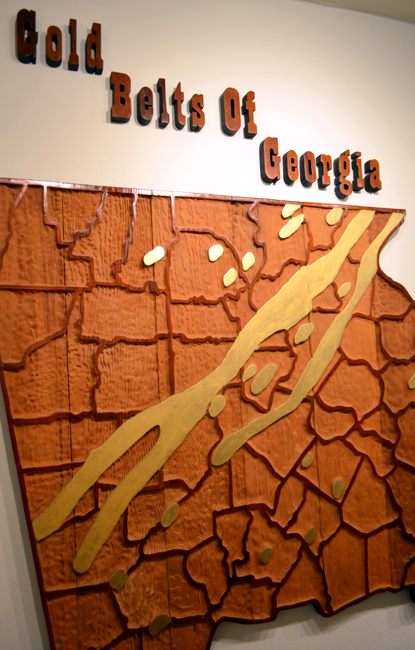
Gold Belts of Georgia
In 1835, Congress approved Dahlonega to be one of three new U.S. Branch Mints, which went into operation in 1838 and continued minting until the outbreak of the U.S. Civil War.


William Windom, Representative & Senator
Those who know me well will understand my excitement when I discovered a connection between the Dahlonega Gold Rush and Star Trek...yes, Star Trek!

Turns out, the president of the Lumkin-Chestatee Mining Company, William Windom, who also served as a U.S. Representative and a U.S. Senator, is the great-grandfather of the recently deceased actor William Windom, Commodore Decker on Star Trek: The Original Series. Interestingly enough, the Decker character wore a "gold" tunic on the show. Windom had quite the illustrious acting career!


Gold-processing Tools, Dahlonega Gold Museum
Some of the many, many, many gold mining artifacts.


Pick Axe used for mining gold in the 1800s
The Museum has countless artifacts on display and the Museum experience begins with a film that chronicles the history of America's first major gold rush...I highly recommend making time for the video. It's extremely well done.


Five-stamp Mill, Dahlonega Gold Museum
Five-stamp Mill
One of the many artifacts in the Museum is a five-stamp mill that's taller than me and the stamps, used to crush ore to test for gold, were 150 pounds, yet the contraption was moved from mine to mine.


Bornite, Dahlonega Gold Museum
One thing that the Museum is famous for is its rare, complete collection of of U.S. Branch Mint gold coins. While the coins are on public display, photography of them is prohibited. Visitors may make photos anywhere else in the Museum.

There's a LOT more to this Museum, but instead of tell you everything—which would require writing a novel—I'll just encourage you to go visit yourself. It's not that far and it's a lovely drive. 

Head over to the wanderlust ATLANTA Facebook Page where you'll find even more photos from this visit. Enjoy!