Showing posts with label Cherokee. Show all posts

Monday, January 6, 2014

Indians and Georgia

My great grandmother was born on the Cherokee Reservation in North Carolina, so most anything to do with Native American culture captures my attention. The Native Lands: Indians and Georgia exhibition at the Atlanta History Center certainly did.


Native Lands: Indian and Georgia | Atlanta History Center
Unfortunately, this exhibition has just closed, but I wanted to give it a shout out in appreciation to the Atlanta History Center for bringing it in. And, I hope everyone will check out the next exhibition to occupy the same space (the gallery across the hall from the Bobby Jones exhibit).

Native Lands: Indians and Georgia, a traveling exhibit, "celebrates the state's original inhabitants beginning with the Mississippian peoples continuing with their descendants, the Creeks and the Cherokees."

Native Lands: Indian and Georgia | Atlanta History Center
"Long before the European settlers came to what is now called Georgia, the Mississippian Indians developed complex societies on these lands—complete with art, music, ceremony, agriculture, architecture, and trade industries." - Atlanta History Center website

This exhibition delivered everything it claimed. 


Native Lands: Indian and Georgia | Atlanta History Center
One of the things that I really liked about this exhibition is that it didn't stop at the Trail of Tears...it continued on to discuss Indians' connection to Georgia today. The only thing that I missed was an ample display of actual artifacts. There were a few, but mostly they were reproductions. The important thing though is that visitors learned a lot about Indian culture in Georgia. Again, color me grateful.

Oh, and one of my favorite parts of the exhibition was a station that teaches visitors some Cherokee vocabulary. That was fun!

Native Lands: Indian and Georgia | Atlanta History Center
I'd never thought about it, but learned in this exhibition that—prior to colonization—no individual could sell or give land away...no individual could own land. Indians' concept of land was considerably different from the European settlers.


Native Lands: Indian and Georgia | Atlanta History Center
An emotional challenge to read through, the exhibition noted in a decent amount of detail, the process of removal—and use of "camps". The number of Native Americans lost to relocation and removal is staggering, and heartbreaking!

If you're studying or are an enthusiast of political science, you'd find the markers showing the influence by various politicians of the day—both for and against relocation—of great interest. There are some surprises there, I think.

On the flip side of that coin, the exhibition brings to light some of the contributions Native Americans made to modern day society...and there are more than most think. And it shows the European influence in Indian culture, as well.


Native Lands: Indian and Georgia | Atlanta History Center
I told you that my great grandmother was born on the Cherokee Reservation in North Carolina. My more than half Cherokee grand mother—who passed a number of years ago at 83...I miss her so—was a mere 4'9" and I loved spending time with her. 

My other grandmother and one grandfather had a considerable amount of Cherokee, so I have a lot of Cherokee in me, even though what you see is the English/Irish from my father's side of the family. You would never know that my mother is my mother. She has dark hair, a dark complexion, brown eyes, amazing cheek bones...and she did some modeling when she was young (said her proud son). 

Sadly, there's been more than once when someone said something off color about Native Americans, not knowing my heritage, to which I made it very clear that such comments are totally unacceptable. Be careful what you say...you just never know!


Native Lands: Indian and Georgia | Atlanta History Center
This exhibition, like most exhibitions at the Atlanta History Center, was included in regular admission...and free for members! The next listed upcoming exhibition is titled Following the the Bartrams' Footsteps, an exhibition that promises to excite and fascinate!

Saturday, November 2, 2013

Go West, via the High

Go West! Art of the American Frontier opens tomorrow at the High Museum of Art. I had the pleasure of viewing the exhibition the other day and find it to be quite remarkable. Now, granted I have ties to the West...


"Go West!", High Museum of Art
Let me share those connections with you and then I'll share with you how exciting this exhibition truly is. 

Originally from the East Coast, I spent part of my sophomore year in high school in Pinedale, Wyoming, and later moved back to Wyoming—again to Pinedale—for my full senior year in high school. Later I went to Boot Camp and A School in San Diego, California, but Wyoming was considerably more like the Old West.

I've visited most of our Western states, one of the most memorable being The Grand Canyon—during a helicopter tour of the Canyon. That was great fun! And a rain-free week in Seattle was pretty amazing, too.

Even more personal, my stepfather passed away a few months ago. I loved him very much. He and my mother were together for 17 years and made many trips to Montana, where he was originally from. He raised and showed horses...he was a real life cowboy. I miss him.


"Go West!", High Museum of Art
And my great grandmother was born on a Cherokee Reservation in North Carolina...not necessarily a tie to the West, but many tribes of Indians are referenced in the exhibition. I miss her so much, but enjoy many pleasant memories of her on a regular basis.

So...Go West! is fantastic. I mentioned that I went to high school in Wyoming. This exhibition hails from Wyoming. Specifically, the vast majority of the 257 artifacts in the exhibition are from the Buffalo Bill Center of the West in Cody, Wyoming.


"Go West!", High Museum of Art
Check this out—and this I didn't know...

This is the 100th anniversary of Buffalo Bill's final visit to Atlanta. His first visit to Atlanta—and this is fantastic to realize—was to perform his Wild West show at the Cotton States and International Exhibition in 1895. So, every time you visit Piedmont Park, you're walking on the same grounds where Buffalo Bill entertained thousands of Wild West hungry fans!


"Go West!", High Museum of Art
So, one of the questions I had going in was whether this exhibition is competing with the Booth Western Art Museum in Cartersville, Georgia—the State's second largest art museum.

Fortunately, the exhibition was curated so as to not compete with Booth. While Booth's collections focus primarily on contemporary Western artists, the Go West! exhibition focuses on Western art from 1830-1930.


"Go West!", High Museum of Art
Go West! features paintings, fashion, drawings, sculptures, photographs, guns and rifles, and perhaps most impressive—or at least most likely to be fan-favorites—are a pair of colt firearms owned by Buffalo Bill and Annie Oakley's gun!


"Go West!", High Museum of Art
Around corner after corner, artifact after artifact help tell the tale of our rather colorful Wild West history, without getting too much into the heavier details—again, it's mostly a focus on Western art.


"Go West!", High Museum of Art
For the art-savvy tourist, you may like to know that the exhibition features works by Albert Bierstadt, Thomas "Yellowstone" Moran, N.C. Wyeth, Frederic Remington, and Charles Russell. I found the collection an impressive balance of art, history, and whimsy in entertaining storytelling...all of the caliber expected of the High, of course.


"Go West!", High Museum of Art
And on the fun side, be sure to bring your camera or camera phone because you'll find in the main lobby one of those pose-behind boards with the cutout faces...you become Buffalo Bill or Annie Oakley! 


"Go West!", High Museum of Art
There is a LOT of programming planned for Go West!, including lectures, a College Night, events for teens, and workshops. Check the High's website for a listing of events!


"Go West!", High Museum of Art
Go West! Art of the American Frontier will be on exhibit through April 13, 2014. Ensure you make time to the High Museum of Art to go see it...you'll be educated and entertained in a way that only the Wild West can. And, this exhibition is not a traveling exhibition...when it's done, it all goes back to Cody, Wyoming, so for many this could be a once-in-a-lifetime opportunity!

Friday, April 19, 2013

Dahlonega Gold Museum

On the way home from a recent vacation to the North Carolina mountains, we stopped in Dahlonega, Georgia, to visit the historic town—and quite a charming town it is—also home of the Dahlonega Gold Museum


Dahlonega Gold Museum, former Lumpkin County Courthouse
Most Atlantans know Dahlonega as the city where the gold comes from to guild the dome of the Georgia State Capitol Building. But there's so much more to their story. In this post, I'm going to write about the Dahlonega Gold Museum, and touch on a few historic milestones, as well. Enjoy the photos from the Museum intertwined in my reverie.


Lumpkin County safe used 1886 to 1965
First, the building that houses the Museum is actually Georgia's oldest existing courthouse. That's impressive enough, but the courthouse was built in 1836, more than 175 years ago! Of a Federal design with Greek Revival influences, the building nearly met with destruction to put in a parking lot—that was 1965. 


Hand-sewn Masonic Apron
Instead, due to the remarkable efforts of concerned citizens, Lumpkin County sold the building and property to the State of Georgia for $10, which invested $100,000 to  revitalize the structure after which it became the Gold Museum. It's also on the National Historic Register.


Gold and other minerals and precious metals on are display
The word Dahlonega come from the Cherokee word "dalanigei," which means "yellow money" or in another word, gold. 

In 1830, when Georgia assumed ownership of the Cherokee Nation, the land was named Cherokee County, which was later divided into 10 smaller counties, one of them being Lumpkin County.

In 1838, federal troop rounded up the remaining Cherokee Indians and forced them to march to Oklahoma, the deadly "Trail of Tears"...4,000 of the relocated 15,000 Cherokees of that forced exile died.


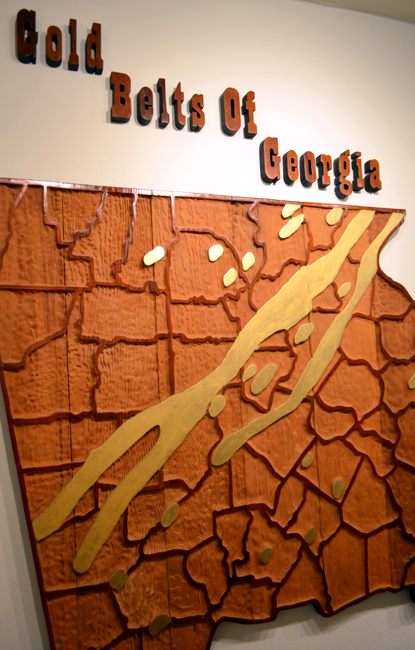
Gold Belts of Georgia
In 1835, Congress approved Dahlonega to be one of three new U.S. Branch Mints, which went into operation in 1838 and continued minting until the outbreak of the U.S. Civil War.


William Windom, Representative & Senator
Those who know me well will understand my excitement when I discovered a connection between the Dahlonega Gold Rush and Star Trek...yes, Star Trek!

Turns out, the president of the Lumkin-Chestatee Mining Company, William Windom, who also served as a U.S. Representative and a U.S. Senator, is the great-grandfather of the recently deceased actor William Windom, Commodore Decker on Star Trek: The Original Series. Interestingly enough, the Decker character wore a "gold" tunic on the show. Windom had quite the illustrious acting career!


Gold-processing Tools, Dahlonega Gold Museum
Some of the many, many, many gold mining artifacts.


Pick Axe used for mining gold in the 1800s
The Museum has countless artifacts on display and the Museum experience begins with a film that chronicles the history of America's first major gold rush...I highly recommend making time for the video. It's extremely well done.


Five-stamp Mill, Dahlonega Gold Museum
Five-stamp Mill
One of the many artifacts in the Museum is a five-stamp mill that's taller than me and the stamps, used to crush ore to test for gold, were 150 pounds, yet the contraption was moved from mine to mine.


Bornite, Dahlonega Gold Museum
One thing that the Museum is famous for is its rare, complete collection of of U.S. Branch Mint gold coins. While the coins are on public display, photography of them is prohibited. Visitors may make photos anywhere else in the Museum.

There's a LOT more to this Museum, but instead of tell you everything—which would require writing a novel—I'll just encourage you to go visit yourself. It's not that far and it's a lovely drive. 

Head over to the wanderlust ATLANTA Facebook Page where you'll find even more photos from this visit. Enjoy!