Showing posts with label Fernbank Planetarium. Show all posts

Friday, August 3, 2012

Cover: Observing Date Night

Atlanta has had a lot of stars in town this summer...movie-making galore! 

But there are other stars who are here all the time and always will be...and you don't have to have a Hollywood connection to see them. A visit to the Fernbank Science Center's Observatory and you can see the most brilliant stars, planets, and the occasional full moon...and while they don't give autographs, star-gazing tends to be much more romantic than celebrity-spotting!

Fernbank Science Center Observatory
Part of the Dekalb County Public Schools system, the Fernbank Observatory is open to visitors--for public viewing--Thursday and Friday evenings (weather permitting) to see the night sky. It's free of charge and is open 9:00 p.m. to 10:30 p.m.

The viewing is hosted by a astronomy professional, usually someone who is enthusiastic about their particular field, enhancing the experience all the more.

If you want a more comprehensive visit, for only $4, there's a planetarium show immediately preceding the opening of the Observatory.

If you really want to impress your friends and/or date, visit the Fernbank Science Center's website to review "This Week's Sky at a Glance" to see what's visible in the current sky. For example, this week, about an hour before sunrise, Betelgeuse, Venus and Jupiter are visible in the east and shortly after sunset in the  east and straight up, Vega is the brightest star.

Just so you know, the Fernbank Science Center is not part of the Fernbank Museum of Natural History, so if making plans to meet there, be clear on which "Fernbank" you're visiting.

Enjoy the above pre-sized Facebook Cover Photo and then head over to the wanderlust ATLANTA Facebook Page and "Like" it, please, and check out the other Cover photos and Atlanta happening!


Thursday, September 8, 2011

ATLANTApix: Moon "Over" Atlanta

The Moon, at Fernbank Science Center
The Moon, Fernbank Science Center
School is back in session which means that a lot of kids will be heading to the Fernbank Science Center to study astronomy, including Earth's moon (photo), as well as geology, animals, plant life, space travel, and an entire host of other scientific subjects...all potential for wondrous discoveries.

The Center is also open to the general public, lucky for us! This particular moon (photo), which hangs just inside the entrance to the Fernbank Planetarium, part of the Fernbank Science Center, is one of hundreds of models throughout the Center that serve as learning tools.

It just so happens that the Fernbank Science Center is part of the Dekalb County School System, so it's perfectly suited for educating our youth...as well as our adults and tourists of all ages.

And remember, the Fernbank Observatory is open to the public on Thursday and Friday nights (weather permitting) for a free viewing of the night sky from 9:00 p.m. until approximately 10:30 p.m.

ATLANTApix and ATLANTAvidz of the tourATLANTA blog features a daily photo or video relative to Atlanta. Come back tomorrow for a new one!

Saturday, February 12, 2011

ATLANTApix: Fernbank Observatory

Fernbank Observatory
The weather in Atlanta is looking up. I also am quite sure that there were a few pre-Valentine's couples looking up at the romantic night sky the last couple of nights at the Fernbank Observatory

Not to worry if you missed this week's stargazing opportunity. The Observatory is open to the public (free of charge) every Thursday and Friday evenings from 9:00-10:30, weather permitting.

Want more time under the stars? The Fernbank Planetarium at the Fernbank Science Center (which also operates the Observatory) has an 8:00 p.m. show that concludes in time for the 9:00 p.m. celestial viewing...through the largest public telescope in the southeastern United States.

The Observatory is free and the Planetarium show is only $4 for adults and $3 for students and seniors...it's so great a bargain, it's practically a gift.

ATLANTApix of the tourATLANTA blog features a "photo-of-the-day" of Atlanta. Come back tomorrow for a new one!

Monday, November 15, 2010

Fernbank Observatory: Starstruck

Fernbank Observatory
The Jim Cherry Memorial Observatory, or Fernbank Observatory as called by locals, is home of the largest public telescope in the southeastern United States and one of the only instruments in the country dedicated solely to education. The telescope also is a source of starstruck excitement for all who peer through it.
The Observatory, part of the Fernbank Science Center, is open for public viewing at dark on Thursday and Friday nights when the skies are clear. Tickets are not required, reservations are not required, and the viewing is free.
When I recently went to the Observatory on a Friday evening, I had just finished a program at the Fernbank Planetarium, located in an adjacent building. The same astronomer who led the planetarium program also served as the host at the Observatory.
She had to close the planetarium projection system down before opening the Observatory so we started a few minutes after the scheduled 9:00 p.m. start time.
Most of the attendees of the planetarium program stayed for the Observatory viewing and dozens more came only for the viewing. There were at least 60 people there, including students, parents on a scientific discovery excursion with their kids, couples who were obviously on a date, and of course a few fun-seeking tourists.
As soon as the gate opened we climbed the steps of the base, built of blocks of granite from Stone Mountain, to the level upon which the 30-foot dome sits.
While we were waiting for our turn to see the stars, a tour guide pointed out constellations using the most powerful laser pointer I’ve ever seen. He later told us, at the prompting of an inquiring student visitor, that to carry that laser pointer requires a license. I believe him given its strength—enough to easily point out the stars he was discussing.
By pure chance, when the astronomer was pointing to a constellation directly overhead, those of us who were engaged in the celestial tour saw a meteor—a shooting star. I think my wish was for the line to move a little more quickly…the temperature had dropped.
Once inside the dome, the line went pretty quickly (wish granted). By then it was 9:30 but we had been so entertained by the second astronomer that we didn’t realize how much time actually had passed. I was thankful for having worn long sleeves though.
By time I got to the telescope viewing point, we’d figured out that the telescope was pointing toward Jupiter. The strength of the Cassegrain reflector telescope allowed us to see Jupiter's orange color and the familiar bands created by the planet’s swirling atmosphere. We also could see the largest four of its 60-plus moons: Ganymede, Callisto, Io and Europa…invisible to the naked eye, but all were shining brightly through the telescope.


(Video: courtesy ESA, depicts the orbits of Jupiter and its largest moons)

It was indeed an exciting moment…seeing so clearly our solar system’s largest planet, once a total mystery to mankind, still largely mysterious to most.
Will I return to Fernbank Observatory? I welcome any chance to gaze at the stars, and given that our planet is continually spinning on its axis, changing the night sky, there will always be something new to see.
Visiting Fernbank Observatory
Date toured: Friday, November 12, 2010
Location: 156 Heaton Park Drive (map and directions)
Parking: Free onsite parking
Cost: Free
Hours: 9:00 p.m. (or dark) – 10:30 p.m., weather permitting (hours change with the seasons)
Website: http://www.fernbank.edu/observatory.htm


Fernbank Observatory Dome

Sunday, November 14, 2010

Fernbank Science Center: Science and Discovery

Space Capsules
Space Capsules
The Fernbank Science Center offers one of the most diverse collections of learning and exploring opportunities—for tourists and locals alike—in one place than I've seen in quite some time. From life on Earth to exploration of the Universe, its offerings include dinosaurs, spacecraft, live animals, a library, a protected forest, a planetarium, and an observatory, just to name a few resources.
As a tourist, one of the best things about the Fernbank Science Center is that the great majority of its resources are free! The only part that necessitates pulling out the billfold is the planetarium, but even that is only a third of the cost of a regular movie ticket.
My recent visit to Fernbank Science Center streamed over two days. The first day I went to the Fernbank Planetarium for a show, "The Many Faces of Hubble," and then to the Fernbank Observatory for a look at the night sky. The second day, I returned to the planetarium for a different show and toured the exhibit hall and Fernbank Forest.
Fernbank Planetarium
The Planetarium
The planetarium offers shows that change with the seasons and a regularly scheduled "In the Sky Tonight" Saturday morning program, which delves into which stars and constellations are visible in the current night sky. The Saturday program is at 11 a.m. with no shows in December.
On my Saturday morning visit, our astronomer took us, virtually, to New Zealand to show us their night sky. It was illuminating that in fact New Zealanders see stars that we never see in Atlanta. And of course there are a few stars that we in Atlanta see that our counterparts on the other side of the planet can only view if they visit us, unless they have an equally generous planetarium host.
The Observatory
The Fernbank Observatory is also free. It's open to the public on clear Thursday and Friday nights at dark. My visit started at approximately 9:00 p.m.
The Cassegrain reflector telescope is so strong that we were able to see Jupiter's multiple bands of orange, beige and white, as well as the largest four of its 60-plus moons: Ganymede, Callisto, Io and Europa. I found myself unable to constrain a verbal, "This is so cool!"
My excitement wasn't at all that of the geek that I know I can sometimes be. It was more a feeling of uniqueness…knowing that at that point in time I became member of a small portion of our planet’s population that has seen a celestial body so clearly and closely. It totally rocked!
I'll share more about the Fernbank Observatory in an upcoming post.
The Exhibits
The greeter at the Fernbank Science Center is the skeletal head of a Tyrannosaurus Rex. While he's not so forthcoming with tour information and show times, he is a prime example of the fine specimens with whom he shares the exhibit hall.
Sea Turtle
Sea Turtle
Each of the exhibits in the main hall is understated, meaning simply that their modesty allows the Center to pack a lot of information into a single, relatively small museum. While modest in size, the exhibits are rich in information.
Continuing past the T-Rex and his entourage of a few other prehistoric creatures one ventures into a land peppered with animals that we see today—some are taxidermy specimens and some of them are living animals!
The most fascinating, I thought, was the honey bee exhibit. There's a honeycomb, inside a plexiglass display, to showcase the amazing architectural feats of these buzzing creatures. But that's not all.
In the corner of the animal section of the exhibit hall, there's a display with "curtains" covering each side of what looks like a sign undergoing renovation.
When you pull back the curtain, you see hundreds, if not thousands, of bees busily making honey. I've never seen an indoor beehive, so that was a unique experience…and I almost missed it!
While I was there, one of the staff scientists stopped by to perform a routine check. Had I not noticed what he was doing (his protective clothing piqued my interest), I might have missed the opportunity to see what was "behind the curtain."
Other live animals on exhibit include a tarantula, various snakes, and poison dart frogs with bright blue and yellow coloring. There are a few other animals as well and even more in the Fernbank Forest.
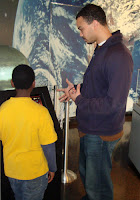
Learning at Fernbank
Going well beyond the confines of Earth's gravity, the Center has a number of exhibits relative to space exploration, including an Apollo 6 command capsule. One of the planetary exhibits is a child-size model of Mars. The space collection features quite a few meteoroids and a fairly large meteor, welcoming touching hands.
I was very impressed with the number of parents and grandparents who brought their children to the Fernbank Science Center, not only on a sightseeing adventure, but to teach them about the diverse worlds of science and discovery.
There were some who were serving as a tour host and then there were others who determinedly spent lots of time with their kids at the learning stations soaking in the experience and engaging them in dialogue. And gauging by the kids' attentiveness, and expanding craniums I'm sure, I wouldn't be surprised to one day learn that I was in the presence of a future scientist.
The Fernbank Forest
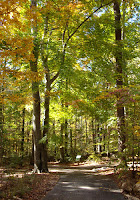
Fernbank Forest
Fernbank Forest
To get to the Fernbank Forest you exit at the back of the building, near the honey bee exhibit. Immediately outside, you have the opportunity to explore several experiments and horticultural exhibits, including one on composting. The grounds are covered with bird feeders and, while I was there, lots of birds were taking advantage of the offer of food and shelter.
Fernbank Forest is a 65-acre expanse of protected land that is, in accordance with the mission of Fernbank, primarily to educate. The curving paths lead visitors on a botanical adventure.
Around every bend of the Forest pathways are many species of animals. I encountered avian creatures of many colors and sizes, butterflies, and dozens of squirrels. Other noted Forest residents include owls, chipmunks, frogs and snakes (it's recommended that visitors stay on the trail), as well as the occasional opossum, raccoon and mink.
I had not realized how pleasant and remarkably beautiful the Forest would be. I also had thought that I’d missed the colorful evidence trees display when they're preparing for the colder months. The reds, oranges, and yellows, mixed with the greens and browns, made the Forest seem incredibly alive, even as it prepares for its winter nap.
Be sure to keep an eye out for the various species of fern, one of which is the Rattlesnake Fern, the Center's logo.
As relaxing as the Forest was, its 1.5 miles of meandering paths also serve as a pleasant little jaunt of exercise.
About Fernbank Science Center
The Fernbank Science Center is part of the Dekalb County School System. The Center is more than I've described here…a lot more. You can learn about the Center's history and offering on its website or at the Center itself.
So, am I satiated with science? Although it took me two days to tour Fernbank Science Center, there's so much more to explore. And each season will present a new experience walking through the Fernbank Forest, learning through a new exhibit, or watching the night sky. I'll definitely be back.
Visiting Fernbank Science Center
Date toured: Friday and Saturday, November 12 and 13, 2010
Location: 156 Heaton Park Drive (map and directions)
Parking: Free parking
Cost: Science Center, Forest and Observatory: Free
Planetarium: Adults $4, Children $3
Hours: Vary (hours)
Website: http://www.fernbank.edu/


Plasma Disc
Plasma Disc